
Ulysses
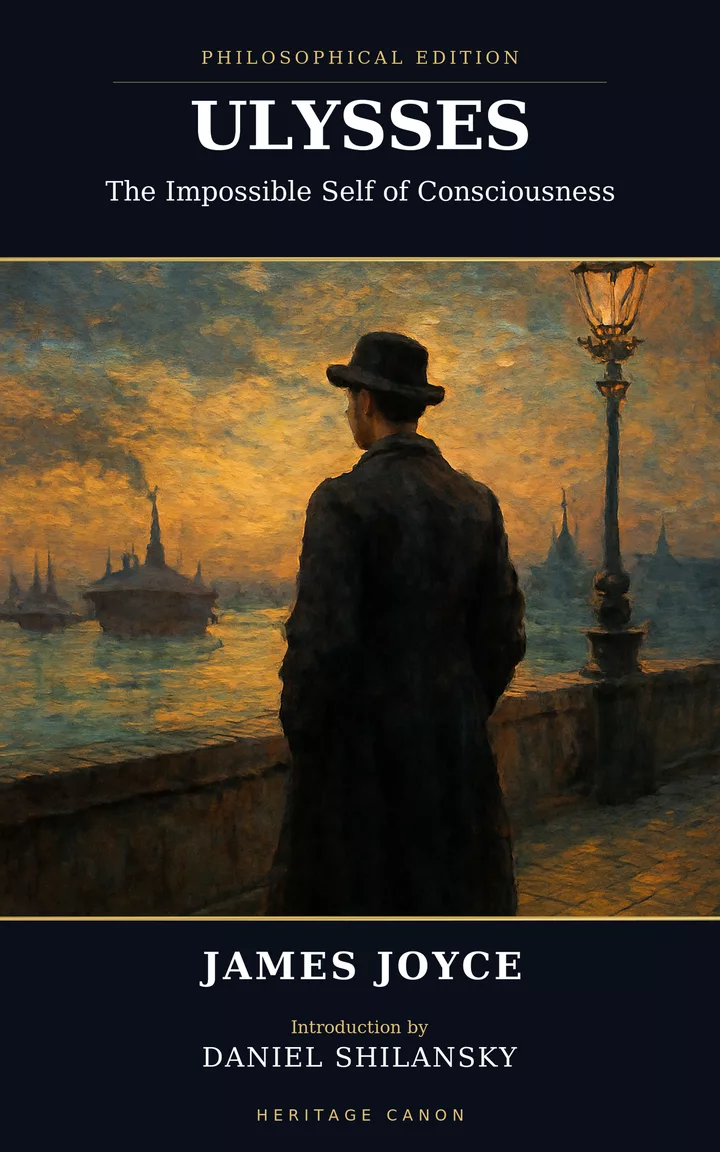
Cover of Ulysses

Philosophical edition

Ulysses

The Impossible Self of Consciousness

James Joyce

Introduction by

Daniel Shilansky

Available formats

Kindle

Original publication

1922

Genre

Novel

The argument

What this edition argues

Leopold Bloom stands on the brink of understanding that Consciousness itself is a fragile illusion, caught in a relentless struggle to know what cannot be fully known. Joyce’s Ulysses confronts us with the impossible self, revealing how every attempt to capture the flow of experience exposes its own structural limits—an insight that challenges the very foundations of how we believe the mind works.

This novel lays bare the dangerous idea that we can ever truly possess self-knowledge, much like how political figures like Vladimir Putin exploit the myth of a stable, unified nation—concealing chaos beneath a veneer of control. Ulysses is a fierce reminder: the deepest truths about human life are forever just beyond reach, and in that gap lies both our freedom and our peril.

It is the ultimate act of intellectual danger—an unflinching gaze at what we dare not fully see.

FAQ

About this edition

What makes this edition different from a standard reprint?

It is not just a reprint of the text. It pairs the complete original work with a new philosophical introduction that reconstructs the conflicts, assumptions, and historical pressures that shaped why the book was written and how it was originally understood.

What does the introduction argue about this book?

Ulysses intervenes in the epistemological dispute between William James and Henri Bergson concerning whether consciousness can be adequately represented in language.

Who is Daniel Shilansky, and what is his role in this edition?

Daniel Shilansky is the editor of Heritage Canon and the author of this edition’s introduction in the Philosophical Editions series. His work focuses on how literature and film participate in philosophical argument, and he writes for both general and academic readers.

Do I need to read the introduction before the novel?

No. You can read it first (if you do not mind plot spoilers) or return to it after the novel; the edition is designed to work either way.

Is the introduction academic or written for general readers?

It is intellectually serious but written for general readers, not only for specialists.

Is this text complete and unabridged?

Yes. The literary text is presented complete and unabridged.

Why does this edition use the label “Philosophical Edition”?

Because the introduction treats the book not just as a plot to summarize or a historical artifact to place, but as an intervention in larger questions of selfhood, morality, religion, desire, freedom, politics, and the shape of modern life.

Continue browsing

More in the catalog