
The Gentleman from Indiana
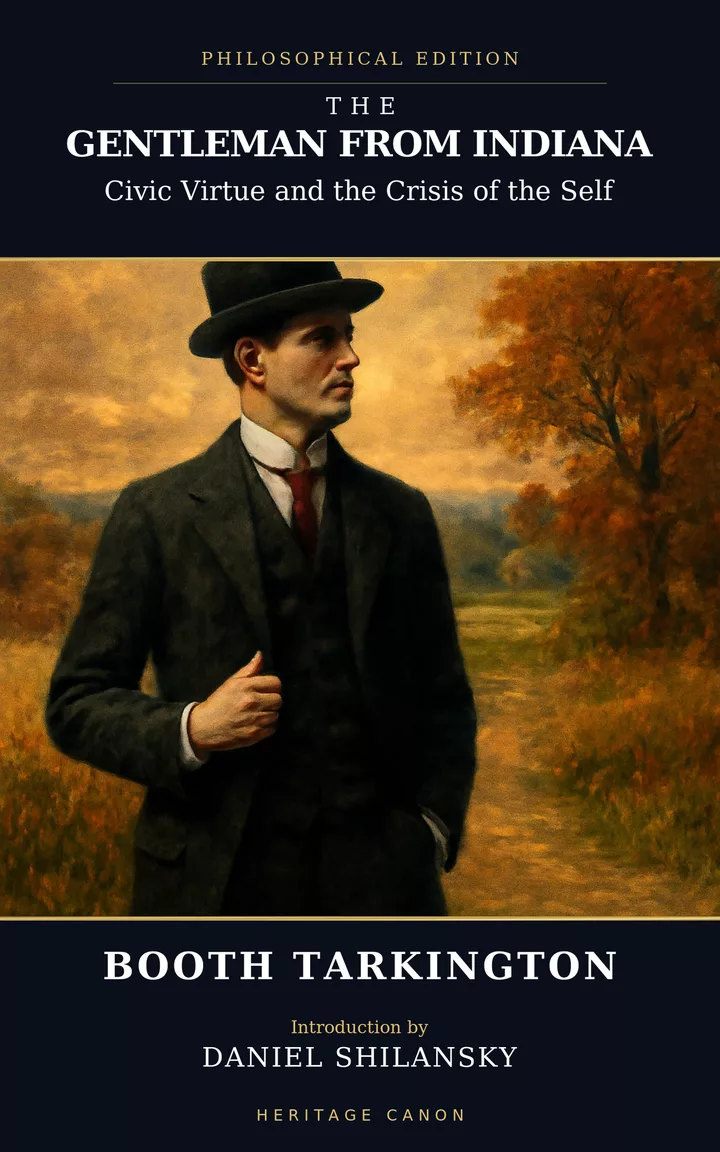
Cover of The Gentleman from Indiana

Philosophical edition

The Gentleman from Indiana

Civic Virtue and the Crisis of the Self

Booth Tarkington

Introduction by

Daniel Shilansky

Available formats

Kindle

Original publication

1899

Genre

Novel

The argument

What this edition argues

In the small Indiana town of Plattville, John Harkless stands at the edge of a crisis, wielding civic virtue as both shield and sword against organized violence that threatens to dismantle the community’s very Self . Tarkington’s The Gentleman from Indiana reveals how the myth of moral influence—often celebrated as civic strength—can mask a darker truth: that true Self-reliance is fragile, built on habits shaped by influence both noble and nefarious.

As Harkless’s personal integrity confronts the organized coercion of White Caps, the novel exposes how democratic communities are haunted by the same social density that can elevate civic virtue or drown it in terror. This is where the mythic figure of the American gentleman and contemporary figures like RFK Jr. converge—they promise moral salvation but often exploit the dangerous idea that Self can be cultivated from above, without community’s consent.

Tarkington's novel hits like a verdict: who we are depends on whether our virtue withstands the unseen convergence of influence and coercion.

FAQ

About this edition

What makes this edition different from a standard reprint?

It is not just a reprint of the text. It pairs the complete original work with a new philosophical introduction that reconstructs the conflicts, assumptions, and historical pressures that shaped why the book was written and how it was originally understood.

What does the introduction argue about this book?

The thesis advanced is that Tarkington's novel stages this conflict with unusual honesty, appearing to endorse the educative view through its reformist sympathies and optimistic arc while simultaneously undermining it through the behavior of Plattville during Harkless's absence.

Who is Daniel Shilansky, and what is his role in this edition?

Daniel Shilansky is the editor of Heritage Canon and the author of this edition’s introduction in the Philosophical Editions series. His work focuses on how literature and film participate in philosophical argument, and he writes for both general and academic readers.

Do I need to read the introduction before the novel?

No. You can read it first (if you do not mind plot spoilers) or return to it after the novel; the edition is designed to work either way.

Is the introduction academic or written for general readers?

It is intellectually serious but written for general readers, not only for specialists.

Is this text complete and unabridged?

Yes. The literary text is presented complete and unabridged.

Why does this edition use the label “Philosophical Edition”?

Because the introduction treats the book not just as a plot to summarize or a historical artifact to place, but as an intervention in larger questions of selfhood, morality, religion, desire, freedom, politics, and the shape of modern life.

Continue browsing

More in the catalog