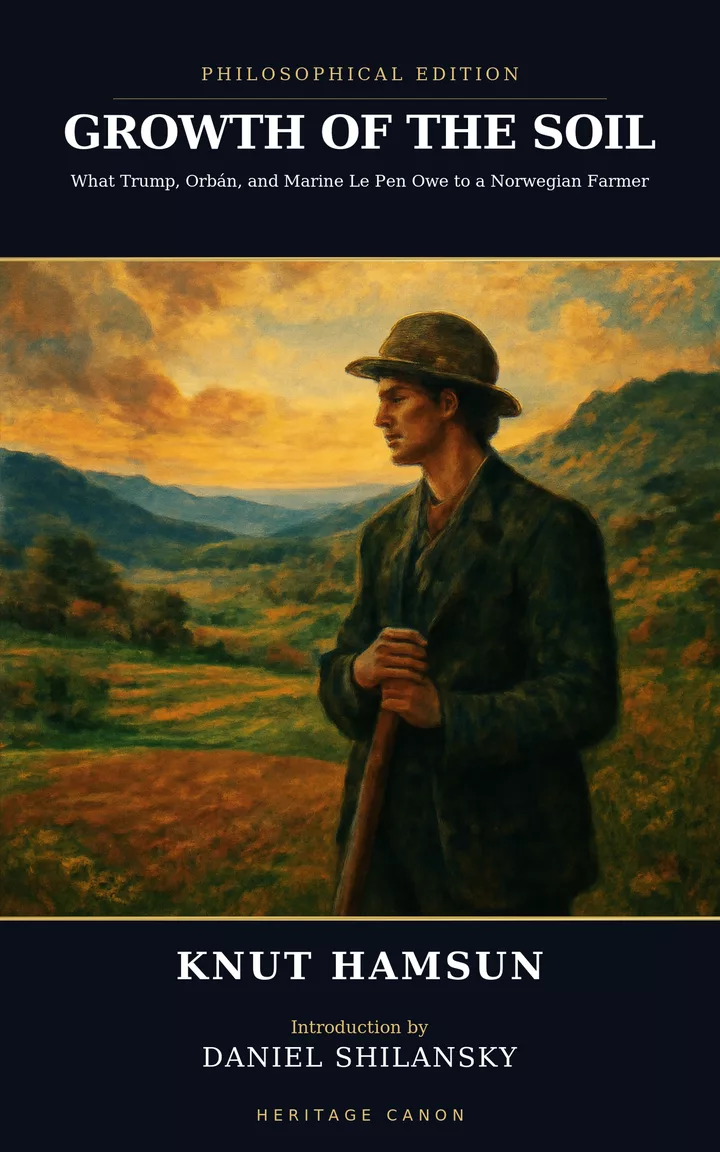

Growth of the Soil
Cover of Growth of the Soil

Philosophical edition

Growth of the Soil

What Trump, Orbán, and Marine Le Pen Owe to a Norwegian Farmer

Knut Hamsun

Introduction by

Daniel Shilansky

Available formats

Kindle, Paperback, Hardcover

Original publication

1917

Genre

Novel

Related essays

The argument

What this edition argues

Knut Hamsun’s Nobel Prize-winning novel, Growth of the Soil, charts the elemental journey of a man carving a life from the wilderness, driven by instinct and a profound connection to the land. This saga of rootedness and self-sufficiency reveals the seductive power of an organic myth, one that venerates the untamed soil and the individual who tames it, embodying a life untouched by modern doubt.

Yet, Hamsun refuses to romanticize this vision, making visible the distance between genuine belonging and the sentimental longing that can be manipulated for power. This Heritage Canon Philosophical Edition, with a new introduction by Daniel Shilansky, unpacks the contemporary resonance of Hamsun’s work, revealing what figures like Trump, Orbán, and Marine Le Pen owe to this Norwegian farmer.

Shilansky exposes how the novel’s dangerous myth—that true belonging can be reclaimed through borders and blood—has been weaponized by these leaders to rally their followers. Growth of the Soil emerges not as an endorsement, but as a prescient warning for our time.

FAQ

About this edition

What makes this edition different from a standard reprint?

It is not just a reprint of the text. It pairs the complete original work with a new philosophical introduction that reconstructs the conflicts, assumptions, and historical pressures that shaped why the book was written and how it was originally understood.

What does the introduction argue about this book?

Each introduction advances a specific interpretive claim about the work rather than offering only background or summary.

Who is Daniel Shilansky, and what is his role in this edition?

Daniel Shilansky is the editor of Heritage Canon and the author of this edition’s introduction in the Philosophical Editions series. His work focuses on how literature and film participate in philosophical argument, and he writes for both general and academic readers.

Do I need to read the introduction before the novel?

No. You can read it first (if you do not mind plot spoilers) or return to it after the novel; the edition is designed to work either way.

Is the introduction academic or written for general readers?

It is intellectually serious but written for general readers, not only for specialists.

Is this text complete and unabridged?

Yes. The literary text is presented complete and unabridged.

Why does this edition use the label “Philosophical Edition”?

Because the introduction treats the book not just as a plot to summarize or a historical artifact to place, but as an intervention in larger questions of selfhood, morality, religion, desire, freedom, politics, and the shape of modern life.

Continue browsing

More in the catalog