Far from the Madding Crowd
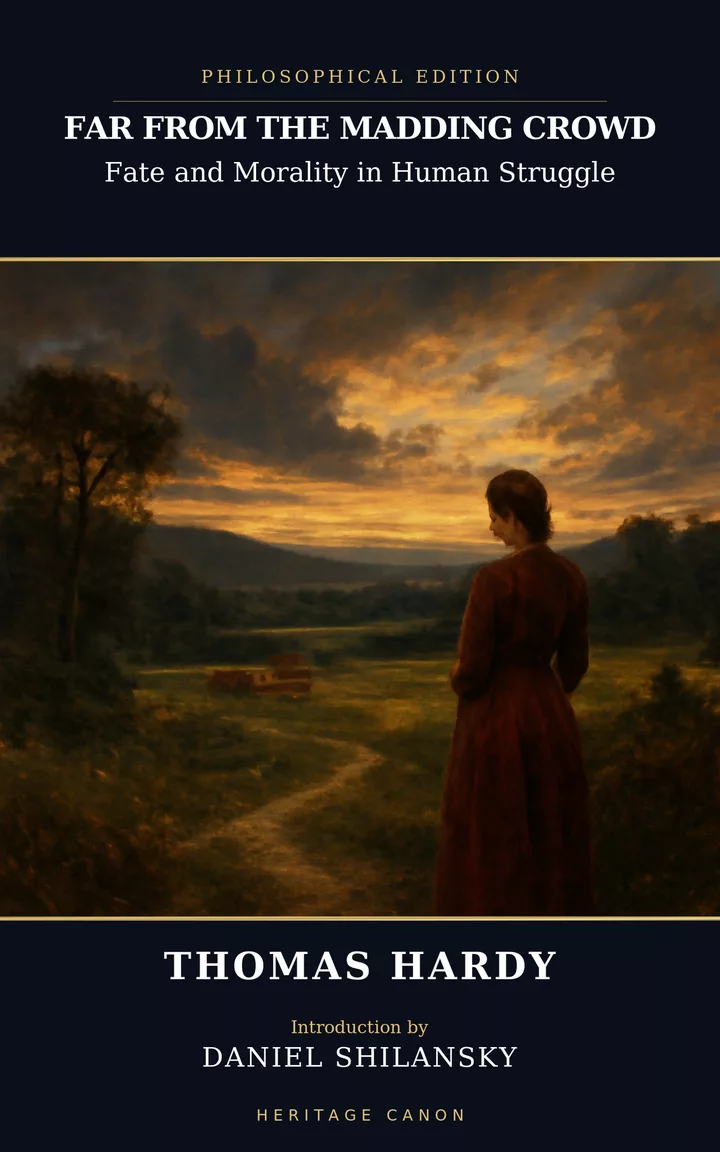
Cover of Far from the Madding Crowd

Philosophical edition

Far from the Madding Crowd

Fate and Morality in Human Struggle

Thomas Hardy

Introduction by

Daniel Shilansky

Available formats

Paperback

Original publication

1874

Genre

Novel

The argument

What this edition argues

Gabriel Oak stands in the middle of a world where Fate’s indifferent hand shapes the course of human Struggle, caught between old Morality’s claim to moral responsibility and the brutal realities of natural process. Hardy’s Far from the Madding Crowd refuses to settle this duel—neither dismissing Morality nor surrendering to the cold logic of Fate.

Instead, it exposes how contemporary figures like Vladimir Putin manipulate these ancient forces—exploiting the illusion that Nature, or Fate, can be harnessed to justify cruelty and chaos. Hardy’s novel demonstrates that beneath their opposition, Fate and Morality converge in a collision that leaves human effort battered and bewildered, yet still vital.

This is a story that dares you to confront the dangerous illusion that human struggle can be reduced to either moral mastery or natural inevitability—and it demands you choose how you will live within that tension.

FAQ

About this edition

What makes this edition different from a standard reprint?

It is not just a reprint of the text. It pairs the complete original work with a new philosophical introduction that reconstructs the conflicts, assumptions, and historical pressures that shaped why the book was written and how it was originally understood.

What does the introduction argue about this book?

The novel constructs a formal irresolution that refuses to adjudicate the philosophical debate between the deterministic views of Spencer and the moral autonomy championed by Mill, emphasizing instead the simultaneous operation of both frameworks.

Who is Daniel Shilansky, and what is his role in this edition?

Daniel Shilansky is the editor of Heritage Canon and the author of this edition’s introduction in the Philosophical Editions series. His work focuses on how literature and film participate in philosophical argument, and he writes for both general and academic readers.

Do I need to read the introduction before the novel?

No. You can read it first (if you do not mind plot spoilers) or return to it after the novel; the edition is designed to work either way.

Is the introduction academic or written for general readers?

It is intellectually serious but written for general readers, not only for specialists.

Is this text complete and unabridged?

Yes. The literary text is presented complete and unabridged.

Why does this edition use the label “Philosophical Edition”?

Because the introduction treats the book not just as a plot to summarize or a historical artifact to place, but as an intervention in larger questions of selfhood, morality, religion, desire, freedom, politics, and the shape of modern life.

Continue browsing

More in the catalog