Alice in Wonderland and Other Tales
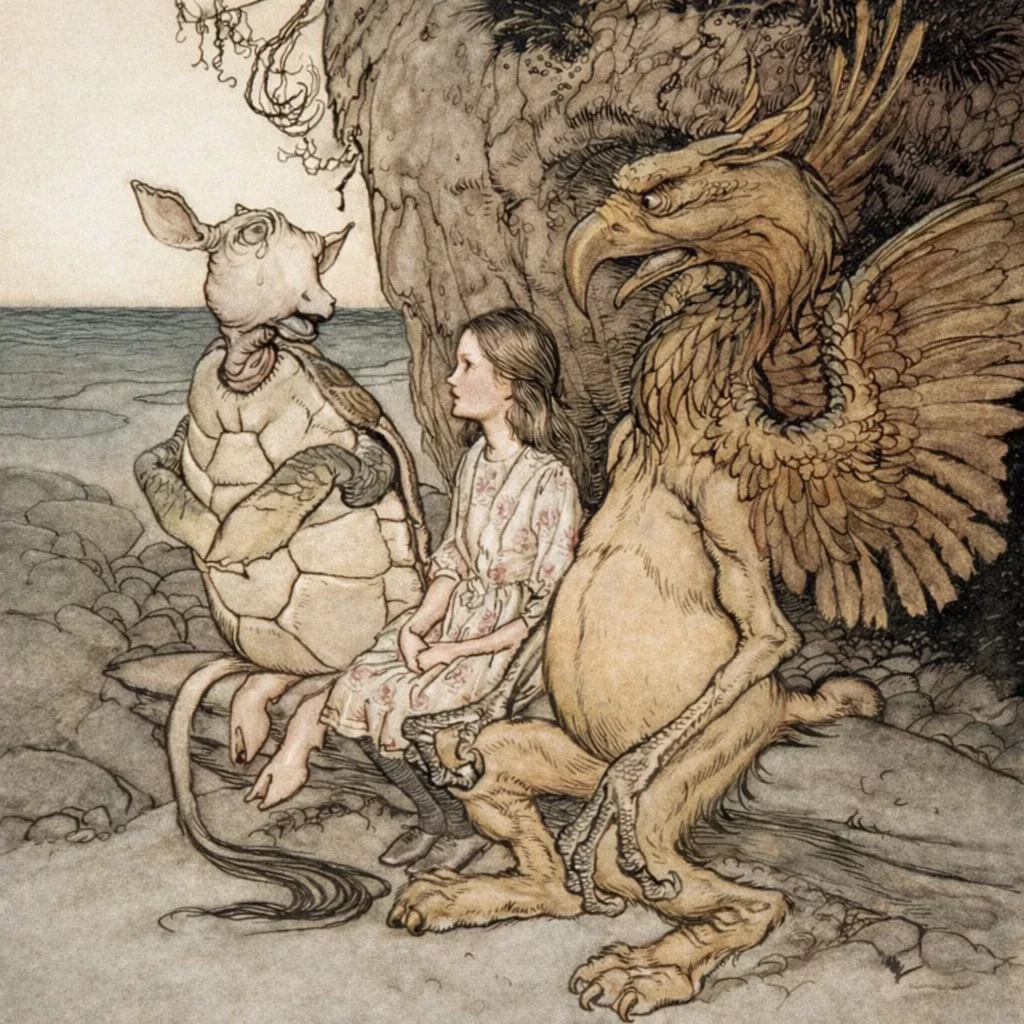
Cover of Alice in Wonderland and Other Tales

Philosophical edition

Alice in Wonderland and Other Tales

The Logic of Nonsense

Lewis Carroll

Introduction by

Daniel Shilansky

Available formats

Kindle

Original publication

1865

Genre

Novel

The argument

What this edition argues

In Lewis Carroll’s Alice's Adventures in Wonderland , Alice faces the impossible task of reasoning correctly in a world where every logical rule, when applied with perfect fidelity, produces nothing but chaos. This novel unearths the dangerous illusion that reasoning power alone can anchor us to reality—an illusion exploited by figures like Vladimir Putin, who manipulate language and law to justify tyranny.

Carroll’s world reveals how the very machinery of logic, when divorced from shared practices and stable references, can serve as a tool for disorder rather than understanding. Both the myth of reason as an infallible guide and the ruthless assertion of will—embodied in authoritarian regimes—share a horrifying convergence: they assume that power and logic are interchangeable, that authority can impose meaning where none exists.

Carroll’s masterpiece warns: when reasoning is divorced from its grounding, all that remains is the illusion of coherence hiding a profound collapse.

FAQ

About this edition

What makes this edition different from a standard reprint?

It is not just a reprint of the text. It pairs the complete original work with a new philosophical introduction that reconstructs the conflicts, assumptions, and historical pressures that shaped why the book was written and how it was originally understood.

What does the introduction argue about this book?

Alice's Adventures in Wonderland dramatizes the gap between formal validity and semantic intelligibility — a gap obscured by both the rationalist tradition (Whately) and the empiricist tradition (Mill), each of which assumed that properly conducted reasoning would find its conditions of application jointly satisfied in any coherent domain.

Who is Daniel Shilansky, and what is his role in this edition?

Daniel Shilansky is the editor of Heritage Canon and the author of this edition’s introduction in the Philosophical Editions series. His work focuses on how literature and film participate in philosophical argument, and he writes for both general and academic readers.

Do I need to read the introduction before the novel?

No. You can read it first (if you do not mind plot spoilers) or return to it after the novel; the edition is designed to work either way.

Is the introduction academic or written for general readers?

It is intellectually serious but written for general readers, not only for specialists.

Is this text complete and unabridged?

Yes. The literary text is presented complete and unabridged.

Why does this edition use the label “Philosophical Edition”?

Because the introduction treats the book not just as a plot to summarize or a historical artifact to place, but as an intervention in larger questions of selfhood, morality, religion, desire, freedom, politics, and the shape of modern life.

Continue browsing

More in the catalog