
The Sleeper Awakes
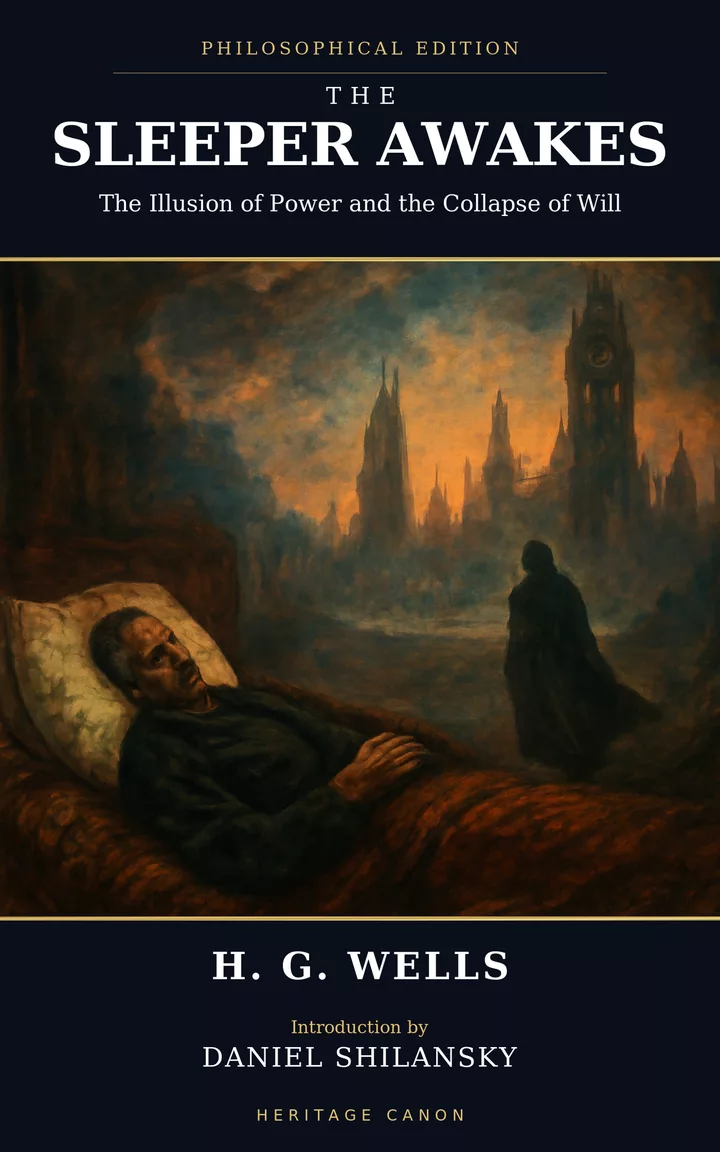
Cover of The Sleeper Awakes

Philosophical edition

The Sleeper Awakes

The Illusion of Power and the Collapse of Will

H. G. Wells

Introduction by

Daniel Shilansky

Available formats

Kindle, Paperback

Original publication

1899

Genre

ScienceFiction

The argument

What this edition argues

In The Sleeper Awakes , Graham’s Victorian morality and grasp of power clash with a future that has been shaped by the illusion of control—an illusion that the novel reveals as a carefully constructed collapse of agency itself. Wells’s vision uncovers how technological mastery and economic concentration have created a world where formal ownership and genuine authority are severed, exposing the dangerous myth that understanding naturally leads to action.

The novel’s world, eerily comparable to the rise of figures like Vladimir Putin or the influence of Big Tech conglomerates today, demonstrates how power can be wielded through systems so complex and autonomous that they dissolve the very capacity for resistance. Wells forces us to confront not only what progress has wrought but how its seductive illusions mask the collapse of will—an insight as relevant now as it was at the dawn of the twentieth century.

FAQ

About this edition

What makes this edition different from a standard reprint?

It is not just a reprint of the text. It pairs the complete original work with a new philosophical introduction that reconstructs the conflicts, assumptions, and historical pressures that shaped why the book was written and how it was originally understood.

What does the introduction argue about this book?

The novel does not argue for simple historical determinism but dramatizes the conditions under which the gap between comprehension and effective agency becomes structural rather than contingent.

Who is Daniel Shilansky, and what is his role in this edition?

Daniel Shilansky is the editor of Heritage Canon and the author of this edition’s introduction in the Philosophical Editions series. His work focuses on how literature and film participate in philosophical argument, and he writes for both general and academic readers.

Do I need to read the introduction before the novel?

No. You can read it first (if you do not mind plot spoilers) or return to it after the novel; the edition is designed to work either way.

Is the introduction academic or written for general readers?

It is intellectually serious but written for general readers, not only for specialists.

Is this text complete and unabridged?

Yes. The literary text is presented complete and unabridged.

Why does this edition use the label “Philosophical Edition”?

Because the introduction treats the book not just as a plot to summarize or a historical artifact to place, but as an intervention in larger questions of selfhood, morality, religion, desire, freedom, politics, and the shape of modern life.

Continue browsing

More in the catalog