The Willows
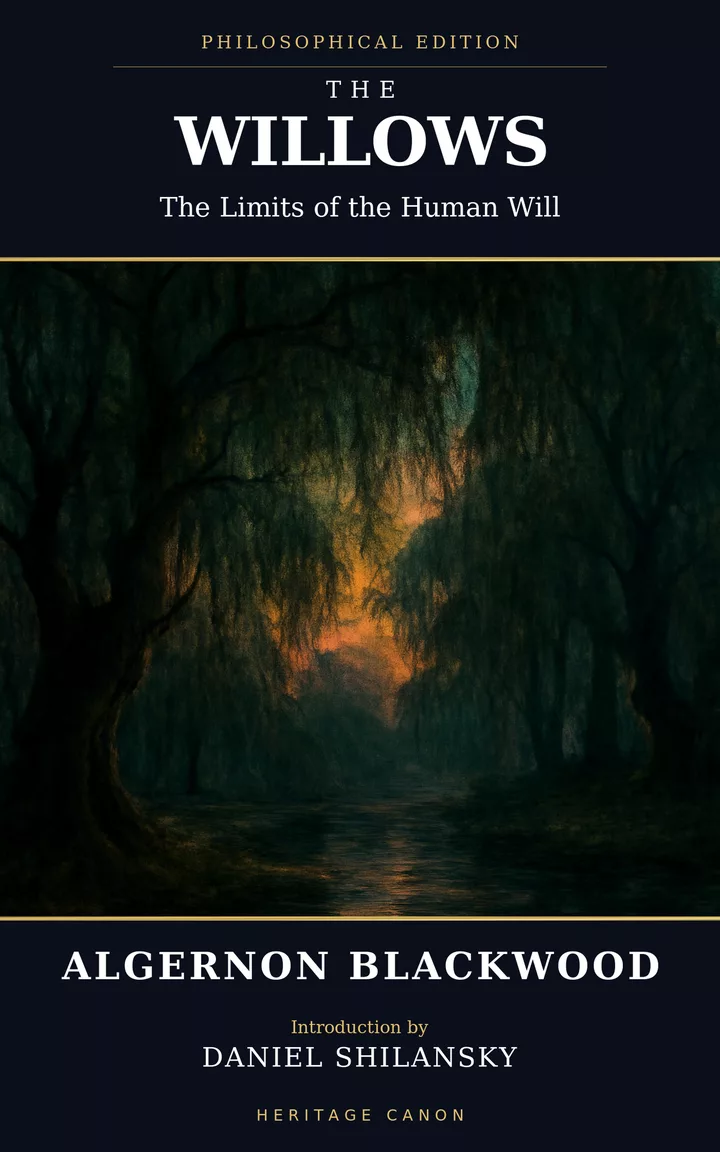
Cover of The Willows

Philosophical edition

The Willows

The Limits of the Human Will

Algernon Blackwood

Introduction by

Daniel Shilansky

Available formats

Kindle, Paperback, Hardcover

Original publication

1907

Genre

Horror

Related essays

The argument

What this edition argues

In Algernon Blackwood’s The Willows, two men venture into a landscape that defies human comprehension, their rational minds buckling under the weight of an ancient, unnameable intelligence. This is a story that confronts the deepest human need for control, exposing the terrifying truth that some forces simply exist beyond our reach, challenging the very foundations of certainty.

It asks whether knowledge can ever truly conquer the unknown, or if some truths are meant to remain hidden, forever whispering at the edge of our perception. This Heritage Canon Philosophical Edition, with an illuminating introduction by Daniel Shilansky, explores The Willows as a profound meditation on the limits of the human will.

Shilansky unpacks Blackwood’s masterful descent into the uncanny, revealing how the story’s enduring power lies in its unflinching portrayal of humanity’s fragile place in a universe far grander and more indifferent than we dare to imagine.

FAQ

About this edition

What makes this edition different from a standard reprint?

It is not just a reprint of the text. It pairs the complete original work with a new philosophical introduction that reconstructs the conflicts, assumptions, and historical pressures that shaped why the book was written and how it was originally understood.

What does the introduction argue about this book?

It contrasts the story’s depiction of encounters with the utterly other—forces that defy categorization and explanation—with dominant naturalist and Romantic traditions, highlighting its unique portrayal of radical alterity.

Who is Daniel Shilansky, and what is his role in this edition?

Daniel Shilansky is the editor of Heritage Canon and the author of this edition’s introduction in the Philosophical Editions series. His work focuses on how literature and film participate in philosophical argument, and he writes for both general and academic readers.

Do I need to read the introduction before the novel?

No. You can read it first (if you do not mind plot spoilers) or return to it after the novel; the edition is designed to work either way.

Is the introduction academic or written for general readers?

It is intellectually serious but written for general readers, not only for specialists.

Is this text complete and unabridged?

Yes. The literary text is presented complete and unabridged.

Why does this edition use the label “Philosophical Edition”?

Because the introduction treats the book not just as a plot to summarize or a historical artifact to place, but as an intervention in larger questions of selfhood, morality, religion, desire, freedom, politics, and the shape of modern life.

Continue browsing

More in the catalog