The Wendigo
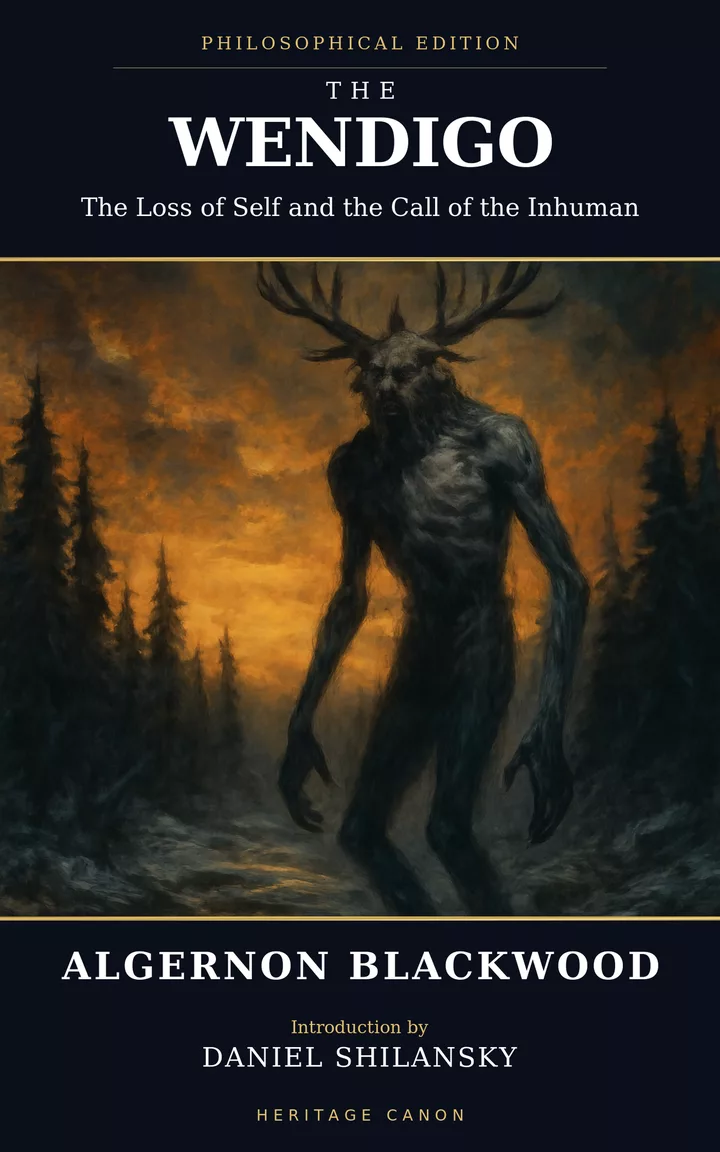
Cover of The Wendigo

Philosophical edition

The Wendigo

The Loss of Self and the Call of the Inhuman

Algernon Blackwood

Introduction by

Daniel Shilansky

Available formats

Kindle, Paperback, Hardcover

Original publication

1910

Genre

Horror

Related essays

The argument

What this edition argues

In Algernon Blackwood’s The Wendigo, a man pursues a primal call into the Canadian wilderness, only to find his very sense of self utterly redirected, his mind pulled irrevocably away from the human. This is not a tale of nature overwhelming or terrifying, but of an encounter that rewires identity itself, challenging the foundations of our understanding of nature’s power and our place within it.

It reveals a terrifying truth: some experiences refuse to be processed, leaving no room for the human subject as we know it. This Heritage Canon Philosophical Edition, with a new introduction by Daniel Shilansky, explores The Wendigo as a profound meditation on the loss of self and the call of the inhuman.

Shilansky unpacks Blackwood’s unsettling vision, revealing how the story cuts through illusions of control and understanding, exposing a raw, unassimilable force lurking beyond reason. The result is an edition that reads Blackwood not merely as a master of the uncanny, but as a prophet of encounters that change us forever, without mercy or resolution.

FAQ

About this edition

What makes this edition different from a standard reprint?

It is not just a reprint of the text. It pairs the complete original work with a new philosophical introduction that reconstructs the conflicts, assumptions, and historical pressures that shaped why the book was written and how it was originally understood.

What does the introduction argue about this book?

Blackwood's The Wendigo functions as a philosophical thought experiment that exposes a shared structural assumption underlying both the Burkean-Kantian sublime tradition and the new experimental psychology of 1910.

Who is Daniel Shilansky, and what is his role in this edition?

Daniel Shilansky is the editor of Heritage Canon and the author of this edition’s introduction in the Philosophical Editions series. His work focuses on how literature and film participate in philosophical argument, and he writes for both general and academic readers.

Do I need to read the introduction before the novel?

No. You can read it first (if you do not mind plot spoilers) or return to it after the novel; the edition is designed to work either way.

Is the introduction academic or written for general readers?

It is intellectually serious but written for general readers, not only for specialists.

Is this text complete and unabridged?

Yes. The literary text is presented complete and unabridged.

Why does this edition use the label “Philosophical Edition”?

Because the introduction treats the book not just as a plot to summarize or a historical artifact to place, but as an intervention in larger questions of selfhood, morality, religion, desire, freedom, politics, and the shape of modern life.

Continue browsing

More in the catalog