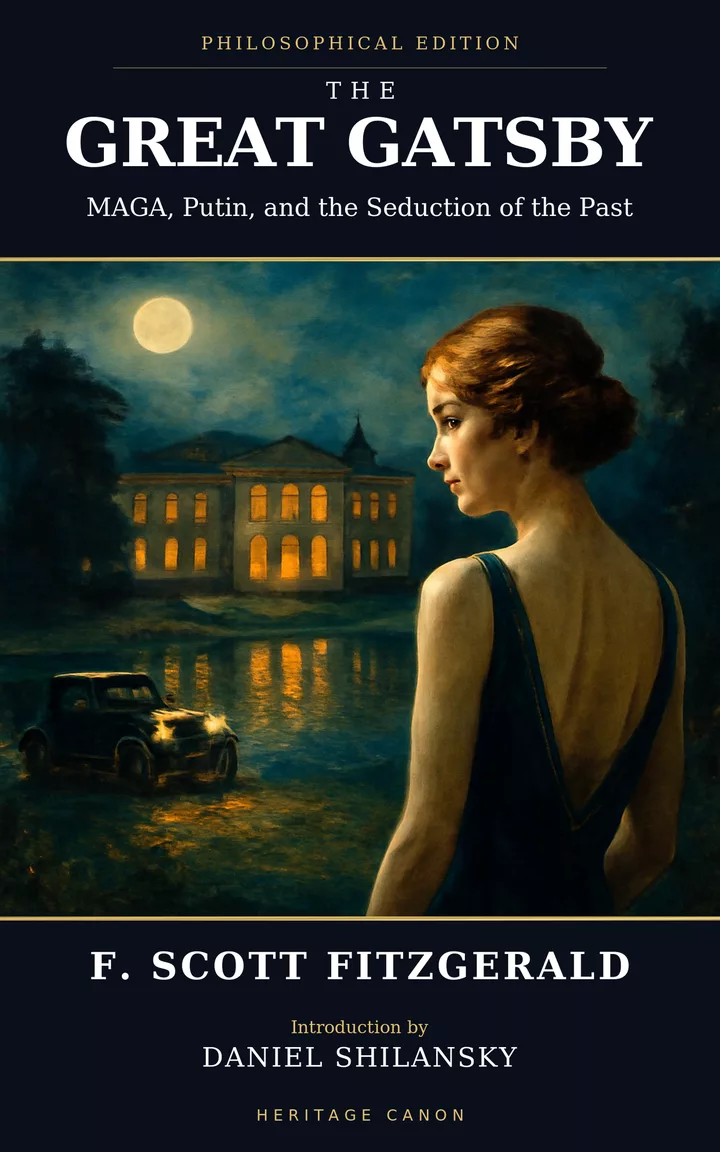

The Great Gatsby
Cover of The Great Gatsby

Philosophical edition

The Great Gatsby

MAGA, Putin, and the Seduction of the Past

F. Scott Fitzgerald

Introduction by

Daniel Shilansky

Available formats

Kindle, Paperback, Hardcover

Original publication

1925

Genre

Classic literature

Related essays

The argument

What this edition argues

The Great Gatsby is one of the great American novels because it sees so clearly the beauty and danger of longing. Jay Gatsby's magnificent act of self-creation is also an act of denial: a refusal to accept time, loss, and the limits of the world.

In Fitzgerald's hands, the story becomes not only a portrait of wealth and illusion, but a profound meditation on memory, ambition, and the human wish to make the past live again. Its elegance never softens its judgment.

This Heritage Canon Philosophical Edition includes a new introduction by Daniel Shilansky, who places Gatsby in conversation with the modern politics of nostalgia. His essay shows how Fitzgerald's novel helps explain the enduring power of retrospective idealization, and why dreams of recovered greatness continue to shape private desire and public life.

The result is an edition that reads Gatsby not as a period piece, but as a diagnosis of a recurring modern temptation.

FAQ

About this edition

What makes this edition different from a standard reprint?

It is not just a reprint of the text. It pairs the complete original work with a new philosophical introduction that reconstructs the conflicts, assumptions, and historical pressures that shaped why the book was written and how it was originally understood.

What does the introduction argue about this book?

It situates Fitzgerald’s work within intellectual traditions such as Emersonian self-reliance, Weberian rationalism, and Nietzschean will, highlighting how these frameworks illuminate the novel’s critique of modern identity and aspiration.

Who is Daniel Shilansky, and what is his role in this edition?

Daniel Shilansky is the editor of Heritage Canon and the author of this edition’s introduction in the Philosophical Editions series. His work focuses on how literature and film participate in philosophical argument, and he writes for both general and academic readers.

Do I need to read the introduction before the novel?

No. You can read it first (if you do not mind plot spoilers) or return to it after the novel; the edition is designed to work either way.

Is the introduction academic or written for general readers?

It is intellectually serious but written for general readers, not only for specialists.

Is this text complete and unabridged?

Yes. The literary text is presented complete and unabridged.

Why does this edition use the label “Philosophical Edition”?

Because the introduction treats the book not just as a plot to summarize or a historical artifact to place, but as an intervention in larger questions of selfhood, morality, religion, desire, freedom, politics, and the shape of modern life.

Continue browsing

More in the catalog