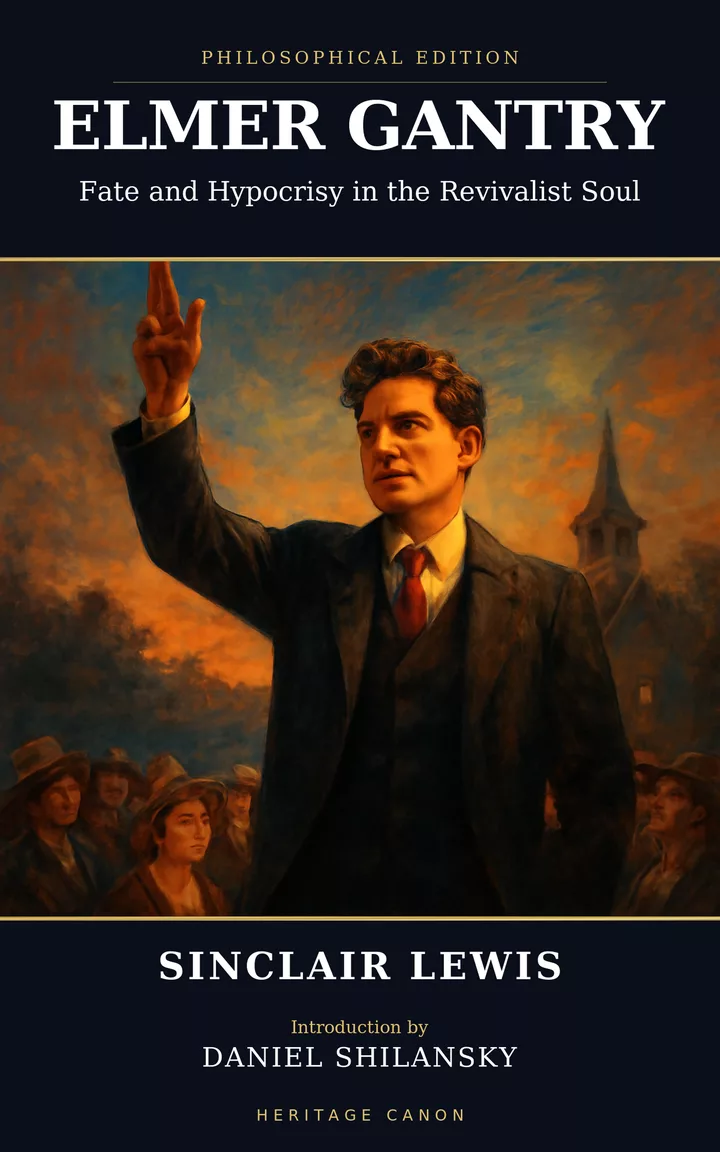

Elmer Gantry
Cover of Elmer Gantry

Philosophical edition

Elmer Gantry

Fate and Hypocrisy in the Revivalist Soul

Sinclair Lewis

Introduction by

Daniel Shilansky

Available formats

Kindle

Original publication

1927

Genre

Novel

The argument

What this edition argues

Elmer Gantry stands at the center of Sinclair Lewis’s Fate and Hypocrisy in the Revivalist Soul , a man whose charismatic performance conceals a void, a hollow shell shaped by an institution that rewards superficial virtue while stripping away genuine faith. His body, his language, his very presence are tools of manipulation, exploiting the emotional vulnerabilities of his followers—an echo of the political spectacle wielded by figures like RFK Jr. or Putin—promising salvation while delivering only self-interest.

Lewis’s novel exposes how revivalism’s structural reliance on spectacle and sensation creates a system that values performance over truth, rewarding the hypocrite who never believed in what he preaches. It’s not simply about fake faith; it’s about the dangerous convergence of institutional design and human fragility—an apparatus that produces emptiness under the guise of righteousness and leaves the soul exposed to manipulation on a mass scale.

This is the revivalist soul Lewis unflinchingly reveals: where genuine belief is secondary to what can be sold, bought, and manipulated.

FAQ

About this edition

What makes this edition different from a standard reprint?

It is not just a reprint of the text. It pairs the complete original work with a new philosophical introduction that reconstructs the conflicts, assumptions, and historical pressures that shaped why the book was written and how it was originally understood.

What does the introduction argue about this book?

Elmer Gantry is best understood as a pragmatist audit of revivalist religion internally divided between two incompatible critical standards: an aesthetic standard inherited from Mencken, which condemns revivalism for its vulgarity and cultural degradation, and a consequentialist standard derived from the pragmatist tradition of James and Dewey, which condemns it for suppressing intelligent self-direction and producing dishonest human types.

Who is Daniel Shilansky, and what is his role in this edition?

Daniel Shilansky is the editor of Heritage Canon and the author of this edition’s introduction in the Philosophical Editions series. His work focuses on how literature and film participate in philosophical argument, and he writes for both general and academic readers.

Do I need to read the introduction before the novel?

No. You can read it first (if you do not mind plot spoilers) or return to it after the novel; the edition is designed to work either way.

Is the introduction academic or written for general readers?

It is intellectually serious but written for general readers, not only for specialists.

Is this text complete and unabridged?

Yes. The literary text is presented complete and unabridged.

Why does this edition use the label “Philosophical Edition”?

Because the introduction treats the book not just as a plot to summarize or a historical artifact to place, but as an intervention in larger questions of selfhood, morality, religion, desire, freedom, politics, and the shape of modern life.

Continue browsing

More in the catalog