
Death comes for the archbishop
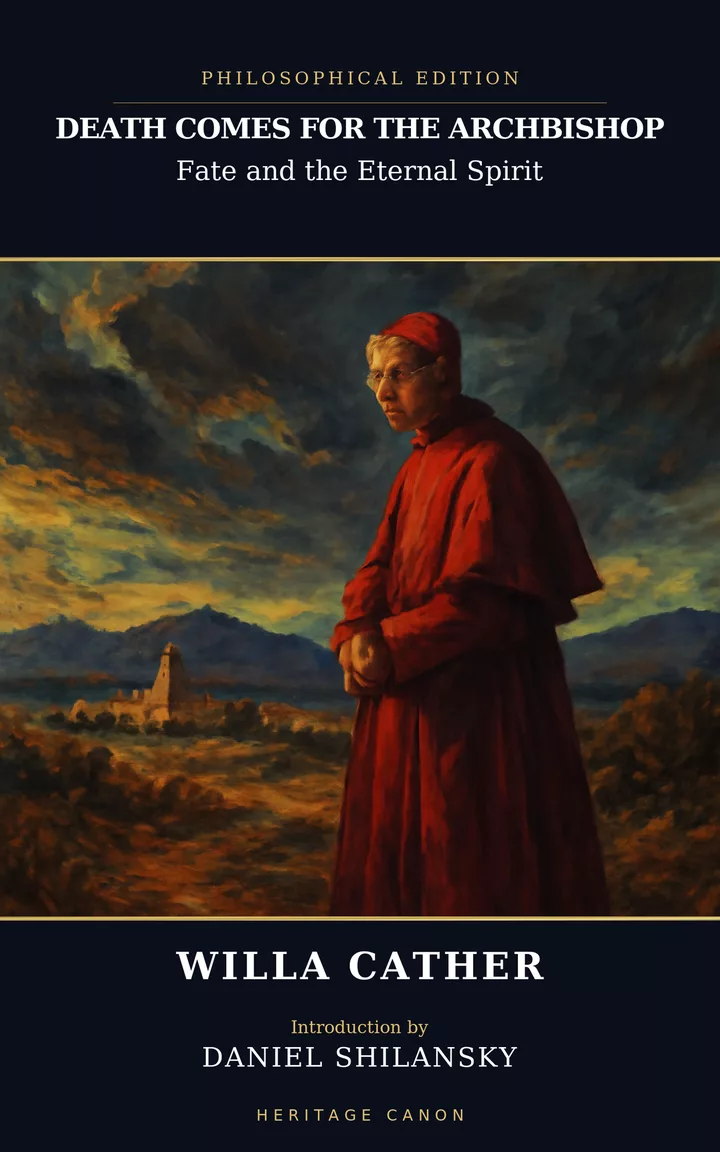
Cover of Death comes for the archbishop

Philosophical edition

Death comes for the archbishop

Fate and the Eternal Spirit

Willa Cather

Introduction by

Daniel Shilansky

Available formats

Paperback

Original publication

1927

Genre

Novel

The argument

What this edition argues

Willa Cather’s Death Comes for the Archbishop, in its quiet grandeur, confronts the enduring tension between historical transience and the eternal spirit. As Bishop Latour establishes the Church in the stark beauty of New Mexico, he navigates a world where human ambition and the sweep of history meet the timeless rhythms of the land and the sacred.

The novel invites us to consider whether faith is merely a product of its time, or if some experiences transcend the relentless march of progress. This Heritage Canon Philosophical Edition, with an introduction by Daniel Shilansky, illuminates Cather’s profound engagement with this question.

Shilansky reveals how Cather, through narrative and landscape, offers a powerful counterpoint to the dominant historical thinking of her era, presenting a vision where fate and the eternal spirit coexist in sustained, unresolved proximity. This edition reintroduces a classic as a vital meditation on permanence in an ever-changing world.

FAQ

About this edition

What makes this edition different from a standard reprint?

It is not just a reprint of the text. It pairs the complete original work with a new philosophical introduction that reconstructs the conflicts, assumptions, and historical pressures that shaped why the book was written and how it was originally understood.

What does the introduction argue about this book?

Death Comes for the Archbishop intervenes in the historicist debate — the dominant intellectual position, running from Hegel through Feuerbach, Marx, and Nietzsche, that all human institutions including religion are products of historical forces and therefore transient — not by refuting historicism on its own terms but by constructing, through formal and narrative means, an experience of time that the historicist model cannot accommodate.

Who is Daniel Shilansky, and what is his role in this edition?

Daniel Shilansky is the editor of Heritage Canon and the author of this edition’s introduction in the Philosophical Editions series. His work focuses on how literature and film participate in philosophical argument, and he writes for both general and academic readers.

Do I need to read the introduction before the novel?

No. You can read it first (if you do not mind plot spoilers) or return to it after the novel; the edition is designed to work either way.

Is the introduction academic or written for general readers?

It is intellectually serious but written for general readers, not only for specialists.

Is this text complete and unabridged?

Yes. The literary text is presented complete and unabridged.

Why does this edition use the label “Philosophical Edition”?

Because the introduction treats the book not just as a plot to summarize or a historical artifact to place, but as an intervention in larger questions of selfhood, morality, religion, desire, freedom, politics, and the shape of modern life.

Continue browsing

More in the catalog