
Babbitt
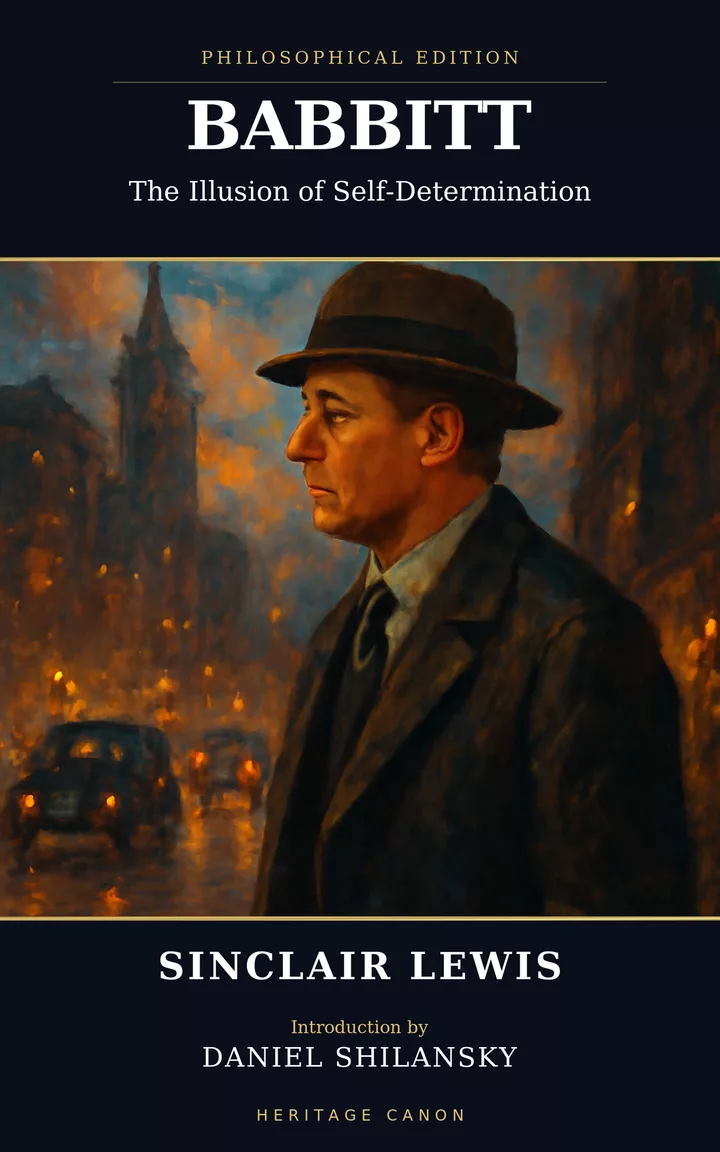
Cover of Babbitt

Philosophical edition

Babbitt

The Illusion of Self-Determination

Sinclair Lewis

Introduction by

Daniel Shilansky

Available formats

Kindle

Original publication

1922

Genre

Novel

The argument

What this edition argues

Babbitt stands on the edge of his life, torn between the comfort of conformity and the gnawing sense that his desires have been hollowed out by a civilization that molds him into a perfect consumer, leaving him unable to imagine a self beyond its rules. This is the peril of a society that erodes individual freedom from within, where the line between who we are and what we’re told to want dissolves into one seamless product.

Sinclair Lewis’s novel captures the nightmare of a self so thoroughly shaped by its environment that rebellion feels impossible—and even unthinkable. Babbitt isn’t just about one man’s mediocrity; it’s about how modern life strips us of the capacity for genuine self-awareness.

This is not a story of change—it’s an indictment of a world that keeps us quiet in our cages.

FAQ

About this edition

What makes this edition different from a standard reprint?

It is not just a reprint of the text. It pairs the complete original work with a new philosophical introduction that reconstructs the conflicts, assumptions, and historical pressures that shaped why the book was written and how it was originally understood.

What does the introduction argue about this book?

Babbitt occupies a precise position in the intellectual debate of 1922 by dramatizing a form of unfreedom that neither the Progressive nor the cultural-critical tradition could fully accommodate.

Who is Daniel Shilansky, and what is his role in this edition?

Daniel Shilansky is the editor of Heritage Canon and the author of this edition’s introduction in the Philosophical Editions series. His work focuses on how literature and film participate in philosophical argument, and he writes for both general and academic readers.

Do I need to read the introduction before the novel?

No. You can read it first (if you do not mind plot spoilers) or return to it after the novel; the edition is designed to work either way.

Is the introduction academic or written for general readers?

It is intellectually serious but written for general readers, not only for specialists.

Is this text complete and unabridged?

Yes. The literary text is presented complete and unabridged.

Why does this edition use the label “Philosophical Edition”?

Because the introduction treats the book not just as a plot to summarize or a historical artifact to place, but as an intervention in larger questions of selfhood, morality, religion, desire, freedom, politics, and the shape of modern life.

Continue browsing

More in the catalog