
Arrowsmith
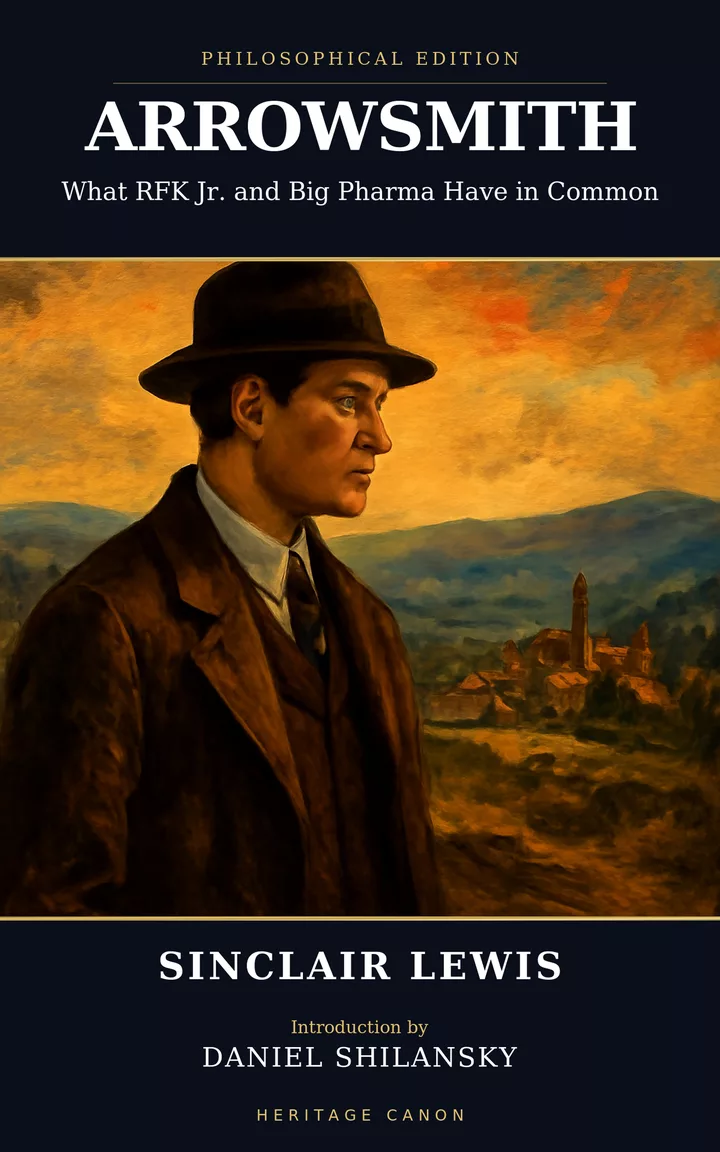
Cover of Arrowsmith

Philosophical edition

Arrowsmith

What RFK Jr. and Big Pharma Have in Common

Sinclair Lewis

Introduction by

Daniel Shilansky

Available formats

Kindle, Paperback

Original publication

1925

Genre

Novel

Related essays

The argument

What this edition argues

Sinclair Lewis's Arrowsmith is a novel about science, ambition, and the institutions that corrupt both. Through Martin Arrowsmith's struggle to preserve intellectual honesty amid vanity, money, careerism, and public pressure, Lewis asks whether truth can survive once research becomes entangled with prestige and power.

It is not simply a satire of medicine or a celebration of scientific idealism, but a study of the moral fragility of modern expertise, and of the cost exacted by any system that rewards influence more readily than rigor.

This Heritage Canon Philosophical Edition includes a new introduction by Daniel Shilansky, who brings Lewis's novel into conversation with the crisis of scientific authority. Reading Arrowsmith against both populist distrust and corporate capture, he shows why figures like RFK Jr. and the world of Big Pharma are not opposites but distorted reflections of the same temptation: the urge to subordinate truth to power, image, and control.

The result is an edition that reveals Arrowsmith as a novel about the moral fate of science in modern life.

FAQ

About this edition

What makes this edition different from a standard reprint?

It is not just a reprint of the text. It pairs the complete original work with a new philosophical introduction that reconstructs the conflicts, assumptions, and historical pressures that shaped why the book was written and how it was originally understood.

What does the introduction argue about this book?

It argues that the novel demonstrates how institutional and social pressures distort these ideals, leading to corruption and ethical dilemmas.

Who is Daniel Shilansky, and what is his role in this edition?

Daniel Shilansky is the editor of Heritage Canon and the author of this edition’s introduction in the Philosophical Editions series. His work focuses on how literature and film participate in philosophical argument, and he writes for both general and academic readers.

Do I need to read the introduction before the novel?

No. You can read it first (if you do not mind plot spoilers) or return to it after the novel; the edition is designed to work either way.

Is the introduction academic or written for general readers?

It is intellectually serious but written for general readers, not only for specialists.

Is this text complete and unabridged?

Yes. The literary text is presented complete and unabridged.

Why does this edition use the label “Philosophical Edition”?

Because the introduction treats the book not just as a plot to summarize or a historical artifact to place, but as an intervention in larger questions of selfhood, morality, religion, desire, freedom, politics, and the shape of modern life.

Continue browsing

More in the catalog