A Portrait of the Artist as a Young Man
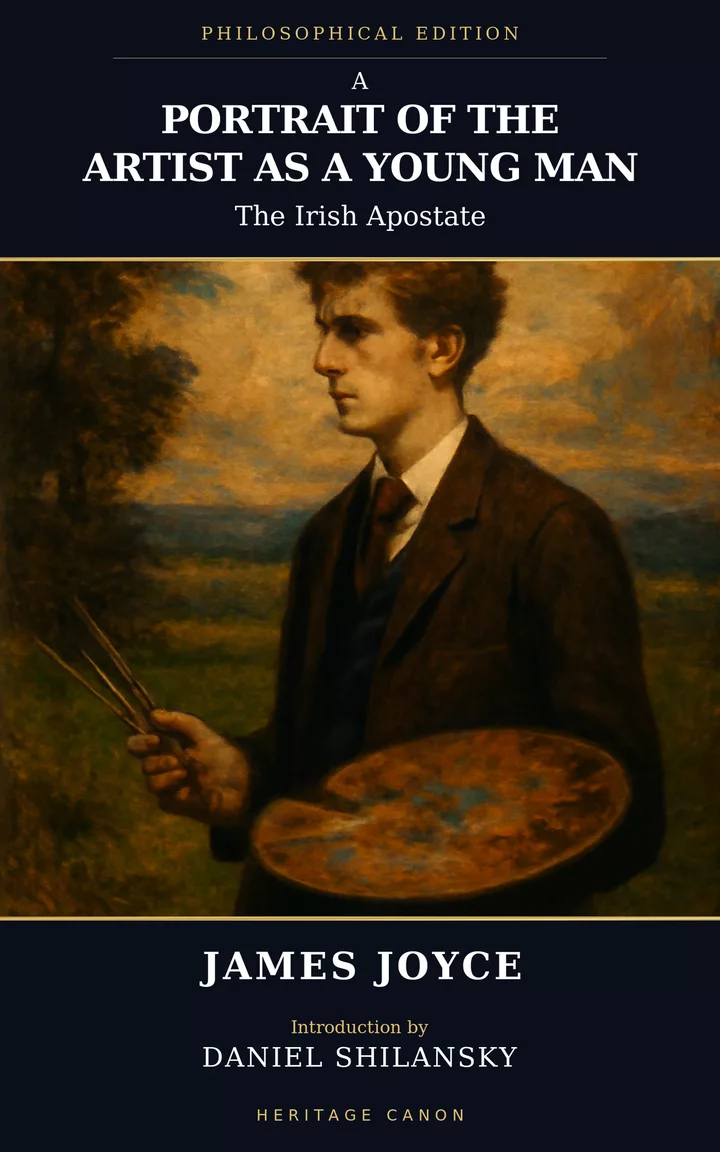
Cover of A Portrait of the Artist as a Young Man

Philosophical edition

A Portrait of the Artist as a Young Man

The Irish Apostate

James Joyce

Introduction by

Daniel Shilansky

Available formats

Kindle

Original publication

1916

Genre

Novel

The argument

What this edition argues

A young Irish Catholic boy, raised to believe his soul is a vessel for divine truth, faces the impossible choice of renouncing his faith or surrendering his artistic independence—knowing that doing either will shatter the identity he’s been told is his destiny. This moment sparks a profound philosophical crisis: what does it mean to truly become oneself when every step is dictated by inherited authority?

James Joyce’s A Portrait of the Artist as a Young Man embodies the Original Deconversion —a ruthless exploration of self-formation, cultural inheritance, and the costs of authentic freedom. It unflinchingly reveals that the self is neither wholly made nor simply given—and that true independence demands a painful, ongoing act of refusal.

This novel is a declaration of independence for anyone daring enough to question their foundations—and brave enough to forge their own path.

FAQ

About this edition

What makes this edition different from a standard reprint?

It is not just a reprint of the text. It pairs the complete original work with a new philosophical introduction that reconstructs the conflicts, assumptions, and historical pressures that shaped why the book was written and how it was originally understood.

What does the introduction argue about this book?

A Portrait of the Artist as a Young Man intervenes in the idealist-naturalist debate about the status of self-knowledge by occupying a precise third position: it argues, through formal rather than discursive means, that self-knowledge is genuinely transformative without being liberatory in any clean idealist sense.

Who is Daniel Shilansky, and what is his role in this edition?

Daniel Shilansky is the editor of Heritage Canon and the author of this edition’s introduction in the Philosophical Editions series. His work focuses on how literature and film participate in philosophical argument, and he writes for both general and academic readers.

Do I need to read the introduction before the novel?

No. You can read it first (if you do not mind plot spoilers) or return to it after the novel; the edition is designed to work either way.

Is the introduction academic or written for general readers?

It is intellectually serious but written for general readers, not only for specialists.

Is this text complete and unabridged?

Yes. The literary text is presented complete and unabridged.

Why does this edition use the label “Philosophical Edition”?

Because the introduction treats the book not just as a plot to summarize or a historical artifact to place, but as an intervention in larger questions of selfhood, morality, religion, desire, freedom, politics, and the shape of modern life.

Continue browsing

More in the catalog